
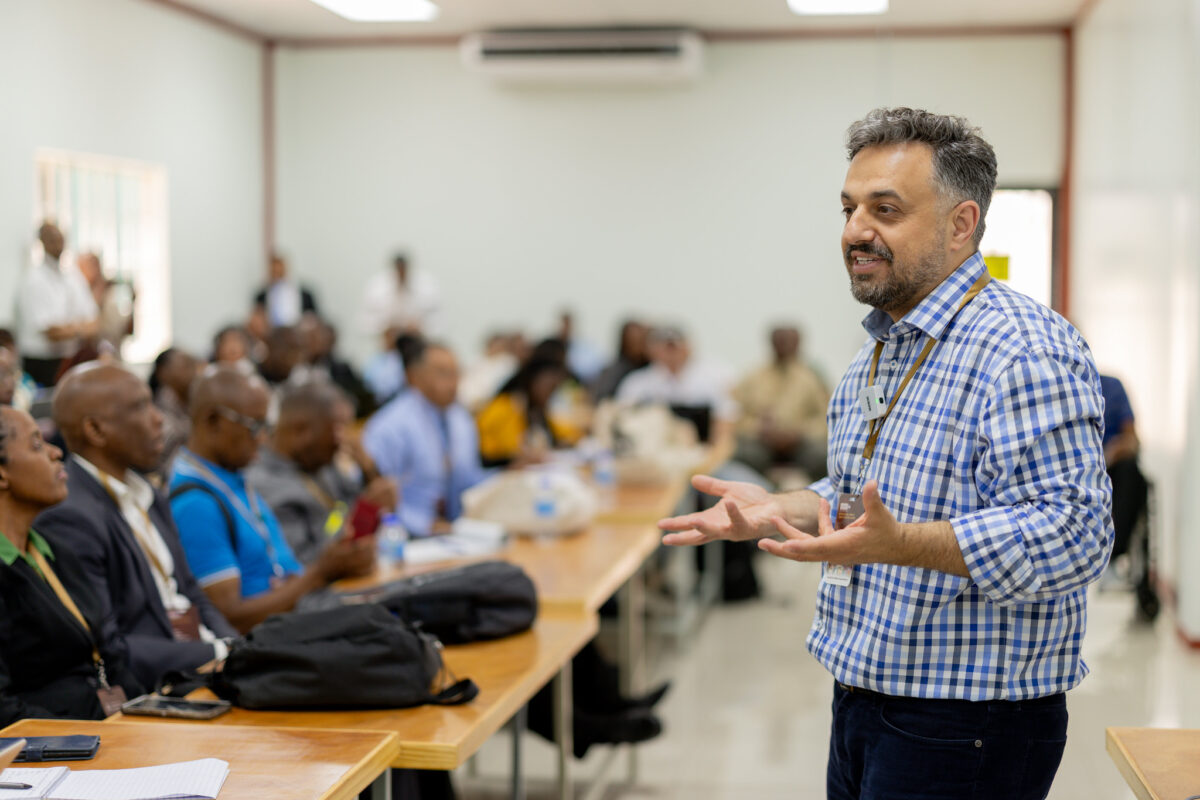
When discussing secular people and their mindset, Bledi Leno knows what he is talking about. “I grew up in Albania, the only country in the world that instituted atheism as the nation’s official status,” he shared. Leno, who now leads Adventist Mission’s Center for Secular and Post-Christian Mission (CSPM) at the General Conference, led a discussion on how to understand the post-Christian worldview during the Intercultural Mission Church Planting Summit in Port of Spain, Trinidad and Tobago, May 29.
During his presentation Leno shared his life story from atheist to Seventh-day Adventist, explained the shift to a post-Christian worldview, and shared how essential it is that those who want to reach those with this worldview first learn the challenges and shortcomings of traditional mission outreach.
Growing Up Without God
“Growing up in Albania, if someone would have asked me what a church, a mosque, or a synagogue was, I would have said they were archaeological places,” Leno shared, explaining the deep impact of generations growing up in an atheistic environment. “Even newer worship buildings had been repurposed to become cinemas or cultural centers.”

How did Albania get to that point? Leno shared that the indoctrination began with his grandparents’ generation. “People were forbidden to celebrate Christmas, Easter, or Ramadan,” he shared. “You couldn’t read the Bible or the Quran without suffering consequences.”
By the second generation (of Leno’s parents), religion had become less relevant, he shared. “There was a fear that if you [chose to believe], you’d be persecuted and imprisoned, and you’d hardly make it out alive.” Sadly, many Adventist pioneers were persecuted and killed.
Thus, by the time Leno grew up, “religion and God weren’t topics of conversation.”
The Role of Church Planting
Leno said church planting is very dear to his heart because the way he came to know God was “through missionaries who left everything behind and went to plant churches and preach the gospel in a place where no one had ever heard it,” he shared. “It meant starting from scratch, not only teaching the Word but preaching with their lives.”
At the same time, those missionaries couldn’t preach by saying, “This is what the Bible says,” Leno explained, “because I didn’t know what the Bible was, and I didn’t care.”
In that context, the way those first missionaries did it, Leno shared, was “through their lives—they shared life and gained our trust.” That trust led to my curiosity: Why are they doing this? Why are they here? What do they want from me? I would ask myself.
Ministering in a Secular Environment
Years later Leno applied that method when ministering in an outreach center in New York City. He explained that in the big cities of the world, “those who have it all rub shoulders with the homeless—those who have nothing. . . . And we are commanded to reach out to them.”
Leno shared the experience of a woman who arrived at a church plant in Bryant Park in Manhattan. She told us right away that she didn’t believe in the Bible “or anything,” so he and his fellow pastor backed off immediately. “We just sat there in silence,” Leno recalled, “because ministering to secular people sometimes implies sitting there and listening to the silence . . . because sometimes, silence speak volumes.”
The Spirit of the Age
According to Leno, new approaches to ministering to secular people acknowledge that a major cultural shift, which also impacts those who believe, is taking place. “It affects us all,” he explained. “People in cities don’t talk anymore. They’re just there, in silence, looking at their phones.”
To top it off, there has been a shift in mentality, Leno reminded attendees. “In olden times authority would come from the truth of divine revelation. That revelation would provide our values and ethics.”

In a secular environment, however, the center of reality has shifted. “Where faith once placed God at the heart of meaning and morality, secular thought places the autonomous self,” Leno explained. “Personal choice becomes sacred, and authenticity replaces transcendence. . . . The human person is now the final measure of truth, purpose, and goodness.”
Navigating the Post-Christian Reality
Against that background, Leno explained, belief becomes “just one option among many” as original theological authority is rejected. “Post-Christian cultures retain the fruit but reject the root,” he illustrated. “Societies shaped by Christian moral values no longer live under their authority,” Leno shared. “They speak highly of compassion, justice, and dignity, but these ideas are now detached from their original theological roots.”
Such a secular worldview landscape highlights other values, including individualism (the self as the highest moral authority), naturalism (only the physical is real), and rationalism (science and reason as the only reliable paths), Leno explained. “People might tell you, ‘That makes sense to you, but it does not make sense to me,’ ” he elucidated. “So purpose comes from finding it within myself.”
The Paradox of Absolute Autonomy
Coupled with that is an increasing distrust of institutions and a focus on consumerism and pragmatism—what works is above what is true or good, he said.
Leno explained that such a state leads to what has been called “the paradox of absolute autonomy,” which he defined as “a culture that deeply prizes freedom,” but that, paradoxically, “often generates an inescapable undercurrent of loneliness, fragmentation, and emptiness.” It is a situation that leads to increasing frustration, as people tell themselves, “There has to be something more,” Leno said. “And we know what that more is. So when we understand their worldview, we become ready to connect and start building bridges to reach them.”
