
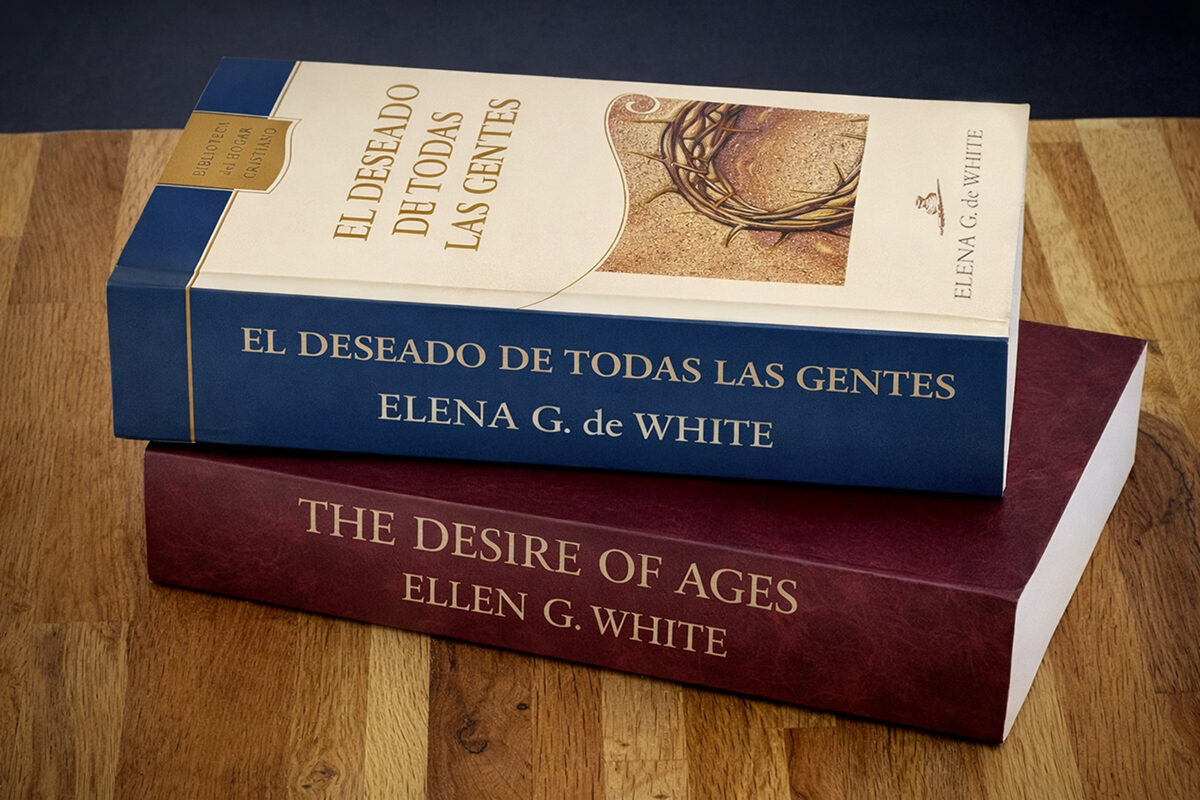
Language has long been a significant barrier to accessing Ellen G. White’s writings. White’s own experience in the mission field shaped her deep awareness of the urgent need to translate her works and other Adventist materials into multiple languages. In 1902 she wrote, “More urgent than these things is the demand for means with which to secure the publication of my books in many languages.”[1]
This statement was written shortly after her return from Australia. While still in the process of finding a permanent place to settle, she carried what she described as her most pressing burden—the translation and publication of her writings for a global audience. In the same letter she explained: “New fields are opening. . . . From Japan, from India, from South America, from Polynesia, and from Europe come appeals for counsel and assistance in having my books translated in the various languages of the people.”[2]
Ellen White concluded with a candid assessment of the situation: “In this work we are far behind our duty.”[3] Her words reflect a direct response to urgent appeals from around the world for translated materials. It is also noteworthy that she personally initiated several translation projects, often using her own funds and, at times, appealing to individuals for interest-free loans to advance this work.
Early Translations of Ellen White’s Writings
The first translation of Ellen White’s writings was a book consisting of three parts drawn from Life Sketches, Testimonies for the Church, no. 31, and Spiritual Gifts, vol. 1. It also included an appendix by James White entitled “The Teachings of the Scriptures Concerning Spiritual Gifts,” which helped provide readers with a biblical orientation to the gift of prophecy.
This book was translated into Danish-Norwegian in 1883. In the same year the General Conference in session voted to commission the translation of Spirit of Prophecy, volumes 2 and 3, into Danish-Norwegian, and to include French, German, and Swedish in the overall translation plan.
During the translation process several difficulties were encountered. Ellen White’s figures of speech and religious phraseology proved to be primary challenges. The situation was so difficult that Willie White, describing the translations, stated: “Several persons were united in condemning each of these translations, and it was difficult to find more than two persons who would speak a good word for either one.”[4]
In an effort to resolve this problem, the translators met every morning to read the books together. This practice helped them reach common ground on how challenging passages should be translated.[5]
Since that time, significant progress has been made in the translation of Ellen White’s writings. Many early translations were produced by individuals working independently, and the White Estate occasionally receives requests to review or correct some of these versions.
Today the recommended approach for translating Ellen White’s writings is through the official translation platform, where the work passes through multiple stages and multiple hands. This collaborative process allows for careful review, discussion, and refinement—similar to the early translation meetings—and results in translations of consistently higher quality.
Recent Translation Developments
There have been significant recent developments in the translation of Ellen White’s writings. A new strategic plan, Sharing the Gift of Light 2.0, seeks to expand access to her works by employing innovative and collaborative approaches to sharing the biblical gift of prophecy around the world.
If the translation of Ellen White’s writings was urgent in her mind in 1902, how much more urgent is this work today?
Mission Languages
The primary focus of the plan is on mission languages, with the goal of enabling nearly 400 people groups to read Ellen White’s writings in their own heart language. Three foundational books have been prioritized for translation in this category: Steps to Christ, The Desire of Ages, and The Great Controversy.
The strategic plan was presented to the General Conference Executive Committee’s Annual Council in 2024 and was formally voted at the General Conference Executive Committee’s Spring Meeting in 2025. This action is historically significant, as the first General Conference-level vote to translate Ellen White’s writings took place 142 years ago.
Adventist Possibility Ministries
Increased recognition of the needs of persons living with disabilities has prompted careful attention to accessible formats for Ellen White’s writings. According to Doug Venn, director of Adventist Possibility Ministries at the General Conference, both sign language and braille vary significantly across the world. In collaboration with Adventist Possibility Ministries, plans are underway to launch global projects designed to serve deaf and blind individuals in culturally and linguistically appropriate ways, ensuring meaningful access to Ellen White’s writings.
Artificial Intelligence
The use of artificial intelligence (AI) has introduced both challenges and new possibilities in the translation process. The Ellen G. White Estate, working in collaboration with world church divisions and publishing houses, is exploring innovative ways to accelerate translation while maintaining high standards of accuracy and quality.
One language group that has taken a leading role in this effort is Chinese. All of Ellen White’s books have been translated into Mandarin using AI-assisted methods, followed by extensive review and editing by human editors. This combined approach has resulted in translations of consistently high quality.
Other language groups are now moving toward complete translations of Ellen White’s works and are demonstrating strong potential for accuracy through AI-assisted processes. In addition, plans are underway to test and support all languages available on the translation platform.
Opportunities for Mission Involvement
The expanding translation initiative has also opened new avenues for mission involvement through VividFaith. These digital missionaries serve remotely, without leaving their home country or place of residence. Through the translation platform they are able to contribute to projects around the world. Hundreds of translation projects are already in progress. This process is also helping to identify translation, editing, and proofreading talents across the globe—skills that can be harnessed to advance broader access to Ellen G. White’s writings.
One Voice 2027: Global Reading Plan
The translation initiative is closely connected with the OneVoice27 global reading plan. In 2027 The Desire of Ages will be read and shared worldwide. It is hoped that by that year a significantly larger number of translations, especially of The Desire of Ages, will be available, supporting a truly global and unified reading experience. Everyone is invited to participate in this global effort by praying for its success.
Meant to Be Shared
If the translation of Ellen White’s writings was urgent in her mind in 1902, how much more urgent is this work today?
Together these initiatives reflect a renewed global commitment to making Ellen White’s writings accessible to every people group, language, and ability. What began more than a century ago as a small but visionary effort has now become a worldwide movement, guided by the same conviction—that the light entrusted to the church is meant to be shared. As the church looks toward the future, the translation of Ellen White’s writings remains not merely a publishing task, but a sacred responsibility to ensure that the message of hope, Christ-centered faith, and biblical truth reaches all people, in every place, in a language they can understand.
[1] Ellen G. White letter 66, April 24, 1902.
[2] Ibid.
[3] Ibid.
[4] Willie C. White to L. E. Froom, Dec. 13, 1934.
[5] Ellen G. White, Selected Messages (Hagerstown, Md.: Review and Herald Pub. Assn., 1980), book 3, p. 464.
