
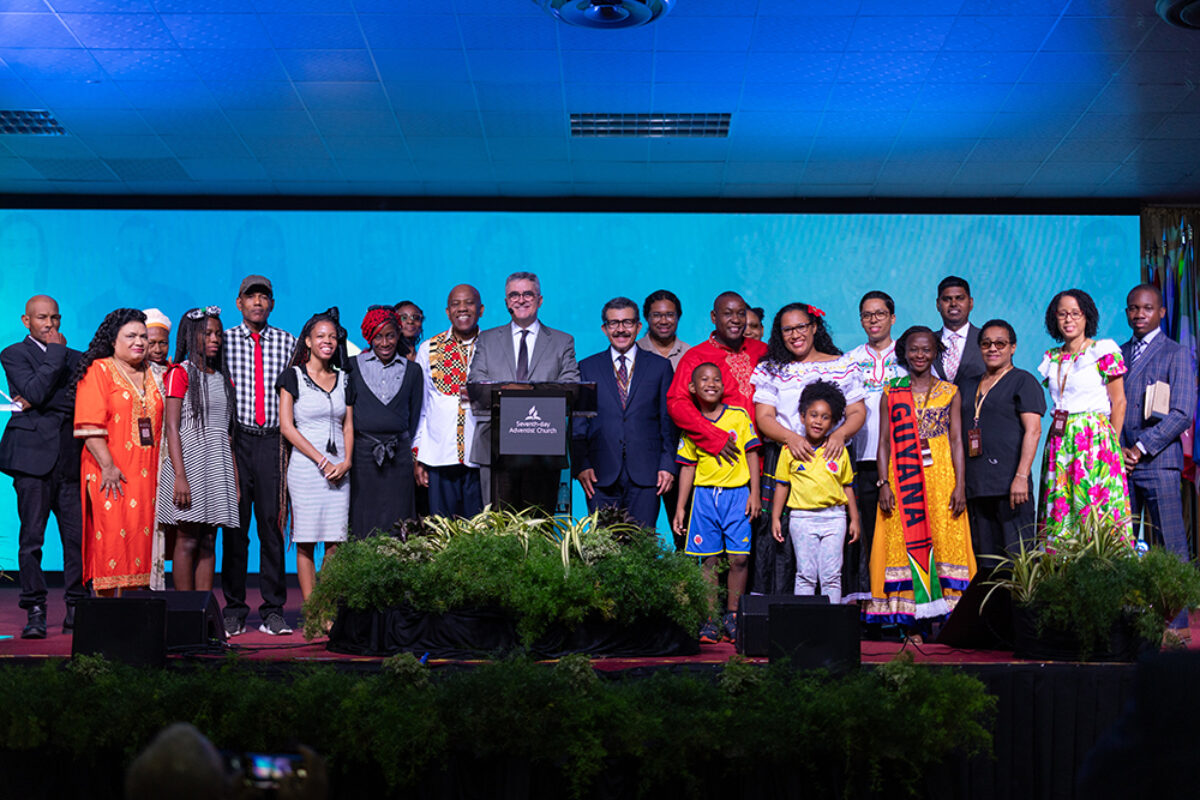
A renewed call for global mission, intercultural evangelism, and church planting marked the closing of the Intercultural Mission Church Planting Summit on May 30 as Seventh-day Adventist Church leaders, pastors, missionaries, students, and lay members gathered at the University of the Southern Caribbean (USC), outside Port of Spain, Trinidad and Tobago.
More than 300 delegates from across the Inter-American Division (IAD) attended the four-day summit to strengthen outreach among urban, secular, indigenous, and unreached people groups around the world through seminars, workshops, worship services, and mission-focused discussions.

The summit culminated with a passionate appeal from General Conference president Erton Köhler, who urged delegates to become active participants in the church’s Mission Refocus initiative. “The gospel is the last sign before the second coming of Jesus,” Köhler said. “Those who love the second coming of Jesus will preach the gospel.”
A Call to Mission Beyond Borders
Köhler reminded delegates that the church’s mission extends beyond local territories. “Our mission is not only for Trinidad,” Köhler said. “Our mission is global.”
Highlighting unreached regions of the world, Köhler challenged attendees with questions such as: “Who will go to Tehran? Who will go to Ahmedabad? Who will go to Damascus?”

He said Mission Refocus aims to strengthen global collaboration by encouraging stronger mission territories to support regions with little or no Adventist presence. “Mission Refocus is a movement calling those who are strong in mission to support those who are weak in mission,” Köhler said.
Near the close of his presentation Köhler invited individuals and families willing to serve as missionaries or volunteers in challenging mission territories to stand and come forward. More than 20 people responded publicly to the appeal. “I expected five people, but mission is a miracle,” Köhler said as delegates continued walking toward the front.
Delegates Respond to Missionary Appeal
Among those responding was Roger Alleyne, a lay evangelist from Tobago who has conducted evangelistic campaigns across the IAD territory and the United States and is pursuing a master’s degree in pastoral ministry at USC. He said the appeal confirmed a calling he had already been sensing. “I always love evangelism,” Alleyne said. “My focus is to go and preach the gospel all over the world.”

Alleyne said he has already begun learning Spanish in preparation for future mission service. “I was sitting there and saying, ‘I should be there,’ ” he recalled. “After they came down and put down their names, I decided I would put down my name too.”
David Springer, part of the pastoral team at the USC church, and his wife, Marbelis, also responded to the appeal alongside their two young sons. “When we got married, part of our marriage commitment was that at some point we would serve as missionaries,” David Springer said.
The couple said Köhler’s presentation renewed their conviction to answer the call. “Whether you have the resources or not, you must be willing to say, ‘God, I will go,’ ” Springer said.

Marbelis, a nurse and USC graduate, said that interacting with delegates from different cultures throughout the summit reinforced the family’s openness to serve anywhere God may lead them. “We are open to any part of the world,” she said.
Inspired by Köhler’s challenge for mission, Noelia Southwell—originally from Guyana and now serving at the South Caribbean Conference—also responded to the appeal. “A lot of times we are fearful that we will go and not be able to do what God wants us to do,” Southwell said. “Pastor Köhler challenged us to be bold, and that gave me the courage to take a step forward.”
Southwell, who previously participated in a church planting project in Mexico and has served as a Bible worker and center of influence coordinator, said she hopes to eventually serve in Africa. “I love studying the Bible and meeting the needs of people,” she said.

Vision for Mission Growth
Throughout the summit IAD leaders outlined an ambitious strategy for accelerating mission growth and church planting across the territory and beyond.
IAD president Abner De los Santos presented the division’s 2026-2030 strategic road map, titled “I Will Go: Living the Mission,” centered on Bible-based mission, unity, collaboration, and church multiplication. “Without mission, we have nothing to do,” De los Santos said. “Mission gives meaning to everything we do in the Seventh-day Adventist Church.”
He challenged churches across Inter-America to become actively involved in evangelism, church planting, and digital outreach initiatives, such as OneVoice27 (a GC initiative for global evangelism culminating in September 2027) and Impact28 (an IAD initiative to establish at least 100,000 preaching centers across Inter-America). “We want to have, in all the territory of the IAD, 100,000 centers of preaching,” De los Santos said.

He also emphasized the division-wide initiative: Every Church, One Church in Five Years. “No church is mature until it reproduces itself,” he said.
Church Planting and Mission Expansion
Samuel Telemaque, Adventist Mission director and main organizer of the summit, reinforced the urgency of multiplication and intercultural church planting. “That’s a very challenging vision, a very uncomfortable vision,” Telemaque said while describing the initiative for every church, district, conference, and union to reproduce within five years.
Telemaque said the summit’s training tracks were intentionally designed to equip delegates with practical skills for urban mission, secular outreach, indigenous ministries, evangelism among diverse people groups, and volunteer missionary service.

As the summit concluded Sabbath evening, leaders prayed over the volunteers who responded to the missionary appeal, expressing hope that a new generation of missionaries would emerge from the IAD to serve unreached communities around the world.
In addition, union leaders received certificates of achievement recognizing church-planting efforts carried out between 2010 and 2025. The recognition was intended to inspire renewed commitment to the initiative Every Church, One Church in Five Years, Telemaque explained.
A report presented by IAD executive secretary Pierre Caporal during one of the May 30 presentations showed that more than 3,000 churches were planted across the IAD between 2010 and 2025. “The ripple effects of the initiative Every Church, One Church in Five Years are enormous and may be beyond our imagination at this time,” Telemaque said. “The multiplication of new churches will create a need for more pastors, schools, universities, church leaders, and church buildings.”

Delegates also received certificates recognizing their participation in seminar tracks and mission-focused discussions throughout the summit.
Delegates Reflect on Intercultural Mission
Several delegates said the summit challenged them to rethink mission beyond traditional evangelistic approaches and to intentionally engage unreached communities through intercultural ministry.
Lowell Ottley, Ministerial secretary and evangelism director for the Tobago Conference, described the summit as “groundbreaking” because it combined missionary recruitment with specialized training for different cultural groups and ministry settings. He said one of the most impactful lessons was learning to understand the social and cultural context of a community before developing evangelistic strategies.

Frank Artavia, a delegate from Costa Rica who served for six years as a dentist and director of an Adventist clinic in Bangladesh, said the church must move beyond simply discussing mission and instead focus on building meaningful relationships with people. “The key will be establishing connections and relationships,” Artavia said. “Sometimes we spend more time talking about mission than actually doing mission.”
He also emphasized the importance of involving young people and using media platforms to share the gospel more effectively.
Deybi Blanco, Adventist Mission director for the East Venezuela Union, said the summit reinforced the importance of unity in reaching multicultural populations throughout the IAD and beyond. “We have thousands of people from different cultural groups living in Venezuela,” Blanco said. “We now have to open ourselves to reach those other cultures residing in our country.”

Blanco said Venezuela recently welcomed a Chinese missionary family to help establish what leaders hope will become the first Chinese Adventist church in Caracas within the next three years.
His wife, Leydis, said the summit helped her better understand the need to break cultural barriers in mission outreach. “We must think beyond ourselves and learn about other cultures so we can genuinely reach people and meet their needs,” Bernal said.
Expanding Mission Training and Global Partnerships
During a Festival of Mission Refocus on Sabbath afternoon, unions across the IAD expressed their commitment to supporting missionary outreach around the world through testimonies, mission partnerships, and reports on church planting efforts across the territory.

Seventh-day Adventist leaders also signed a memorandum of understanding on May 30 establishing the Intercultural Mission Training Institute at USC. The initiative, launched in collaboration with the IAD, the Caribbean Union, the Middle East and North Africa Union Mission, and other church entities, aims to prepare missionaries for cross-cultural service and strengthen global mission engagement and intercultural ministry training.
In addition, leaders encouraged pastors, young professionals, and mission-minded members to pursue advanced missiology training. “Understanding culture and cross-cultural ministry is essential to preparing future missionaries and strengthening the church’s global mission impact,” they said.

The original version of this story was posted on the Inter-American Division news site.
