
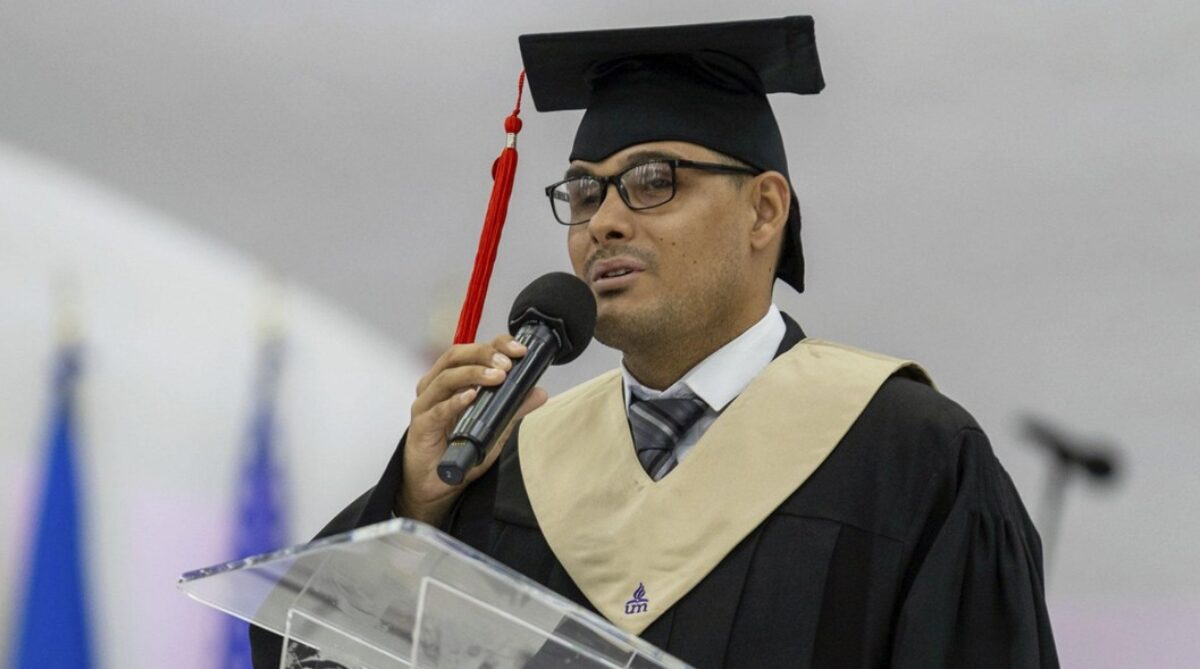
When Colombian student Félix Villalba received his Bachelor of Theology degree from Montemorelos University (UM) in Mexico on May 17, it marked the culmination of a seven-year journey shaped by financial hardship, accessibility barriers, and what he and those around him describe as God’s providential leading.
Born prematurely in Bucaramanga, Colombia, Villalba lost his sight because of retinal detachment in both eyes. From an early age he faced challenges common to many people with visual disabilities, but he remained convinced that God was calling him to ministry.
His spiritual journey took a decisive turn in 2012 when he and his mother, María Delgado, were baptized at the La Joya Seventh-day Adventist Church in Bucaramanga. Three years later, while attending a camp for people with visual disabilities, he sensed a call to pastoral ministry.
Although he initially dreamed of studying music, Villalba said he gradually realized God was leading him in a different direction.
A Door Opens
After graduating from high school in 2016, Villalba sought opportunities to study theology in Colombia. Financial limitations, however, appeared to place that goal out of reach.
A turning point came when he met Edgar Redondo, then president of the North Colombian Union. After learning of Villalba’s desire to prepare for ministry, Redondo encouraged him to contact UM, which offered a virtual theology program.

“After speaking with Félix and seeing not only his unique circumstances but also his desire, dreams, and determination to study and know more of God’s Word, I thought it would be worthwhile to approach Montemorelos University,” Redondo recalled.
According to Lorena Neria, director of UM Virtual, Villalba contacted the institution about seven years ago to ask whether a person with visual disabilities could complete the theology program using adaptive technology.
Although faculty initially recognized the academic and technological challenges involved, Villalba began by taking a single course and eventually completed the entire degree program.
“He handles technology incredibly well,” Neria said. “Nothing discourages him. He has an incredible entrepreneurial and courageous spirit.”
Through ACUDE, an initiative created by UM Virtual to support students with disabilities, Villalba received assistance throughout his studies while gaining ministry experience in partnership with his local church. During graduation ceremonies he was also presented with materials prepared in Braille in recognition of his academic achievement.
Sustained by Faith and Community
The years that followed brought both obstacles and unexpected support.

As he progressed through the program, financial resources often ran short. Yet, according to Villalba, church members, congregations, and supporters repeatedly stepped in to help cover tuition and other educational expenses.
Several times, he said, academic costs appeared impossible to meet, only to discover that someone had already provided the needed support.
Throughout the journey his mother remained one of his strongest sources of encouragement and spiritual support.
Academic demands also presented challenges. Adapting course materials, navigating technology, and meeting university requirements required persistence and discipline. One of the most difficult stages came during the completion of his final research project, which underwent multiple revisions before receiving approval.
Despite the setbacks, Villalba said he remained committed to the calling that inspired him to pursue theology.
A Story of Inclusion and Service
Church leaders say Villalba’s experience highlights the importance of creating educational opportunities for people with disabilities who feel called to ministry.
His story joins that of other Adventists with visual disabilities who have pursued theological education and Christian service, including Víctor Vergara of Caucasia, Colombia, who studied theology in the 1990s and now serves as a teacher of ethics and religious education.

For Redondo, Villalba’s experience demonstrates how God continues to call individuals to ministry regardless of the obstacles they face. “He may not have physical sight, but he has a vision that comes from heaven,” Redondo said. “It allows him to see much farther than many of us.”
Redondo also said Villalba’s perseverance revealed qualities essential for ministry. “The tremendous effort he made during these seven years shows that he has the strength and heart to be a valuable instrument in God’s hands,” he said.
Robinson Pelufo, who worked alongside Villalba in the Campohermoso district, described him as deeply committed to God, mission, discipleship, and local church ministry. Pelufo said Villalba consistently demonstrated a willingness to serve wherever needed and showed strong organizational and leadership abilities despite the personal challenges he faced. “His example demonstrates that when a person responds in faith to God’s call, He opens doors for the gifts He has placed in that individual to flourish,” he said.
A Beginning, Not an End
Today Villalba views graduation, not as the destination, but as another step in his commitment to ministry. “Many times a degree is not the most important thing when it comes to serving God,” he said. “What really matters is attitude and willingness.”
His story illustrates how access, support, and determination can create opportunities for service and ministry, leaders said.
For Villalba, the journey is only beginning.
The original version of this story was posted on the Inter-American Division news site.
