
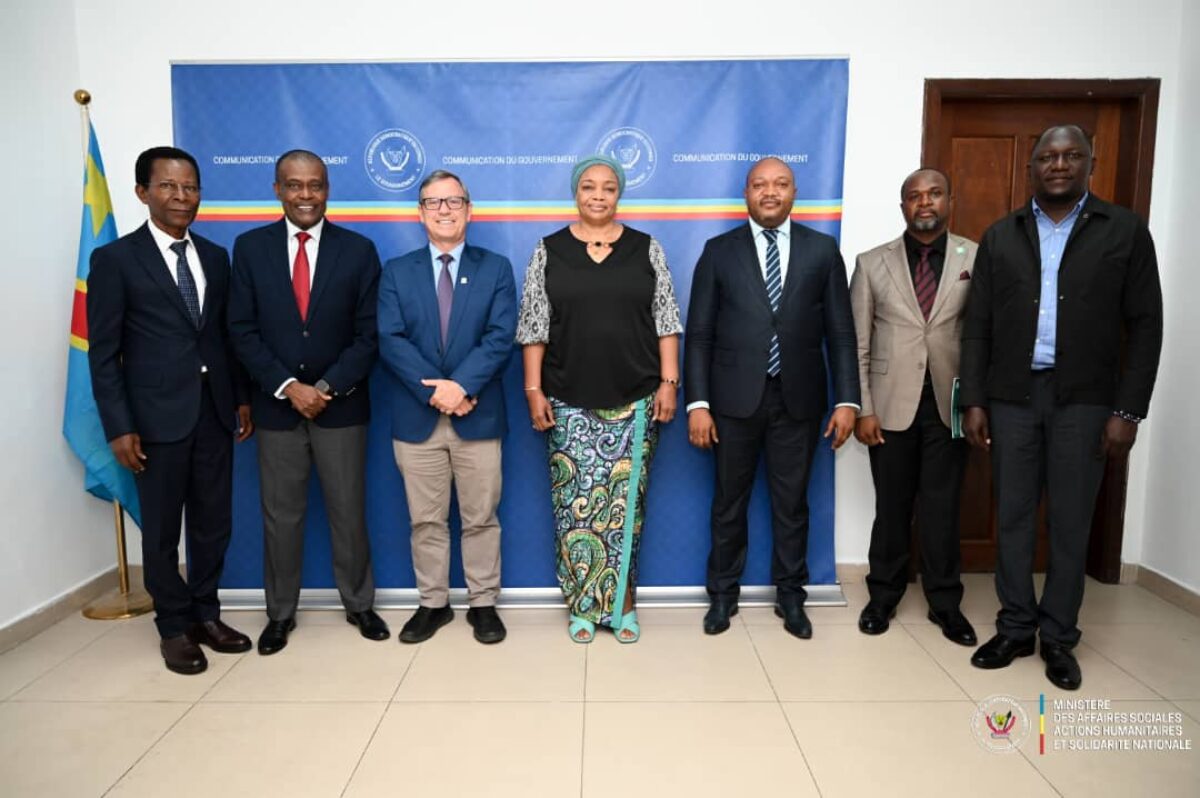
From April 21 to 30 the president of the Adventist Development and Relief Agency (ADRA) International, Paulo Lopes, accompanied by Africa regional director Geoffrey Mbwana, and Africa regional finance director Dibden Chileya, conducted a working visit to the Democratic Republic of the Congo (DRC). During 10 days ADRA reaffirmed its commitment to act on two essential fronts, humanitarian aid and development, for the benefit of the most vulnerable communities.
Amplifying Humanitarian Impact
To maximize the effectiveness of humanitarian actions, Lopes met with the humanitarian coordinator of the United Nations Office for the Coordination of Humanitarian Affairs (OCHA), Bruno Lemarquis, as well as several senior Congolese authorities: Her Excellency Thérèse Kayikwamba Wagner, minister of Foreign Affairs; Her Excellency Ève Bazaiba, minister of Social Affairs, Humanitarian Actions, and National Solidarity; and His Excellency Muhindo Nzangi, minister of Agriculture and Food Security.

At the conclusion of these exchanges, Lopes expressed his deep gratitude for the continued support of the Congolese government in implementing ADRA’s projects. He also encouraged stronger mobilization from government ministries and the presidency to advance advocacy with international donors in support of maintaining and increasing humanitarian funding.
These meetings resulted in commitments of support and renewed engagement in advocacy with financial partners. The mission helped consolidate institutional cooperation and opened the way for strengthened support for ADRA’s initiatives. At the presidency of the republic, Lopes was received by the chief advisor to the head of state in the College of Planning, Agriculture, Fisheries, and Livestock, who pledged to convey this advocacy directly to the president of the DRC.
Witnessing Tangible Outcomes
The mission continued with a field visit to the Tudienzele project, funded by the United States government and implemented by a consortium led by ADRA. Tudienzele aims to sustainably improve food security, nutrition, and the economic well-being of vulnerable households.

In the Kamonia health zone Lopes observed the progress of a bridge under construction on a rehabilitated section of an agricultural service road linking Kamonia to Muamba. On site the mission also highlighted the work of agricultural and fish farming producer organizations, which strengthen production, marketing, and access to resources.
This ambitious program, targeting nearly 1 million participants, operates on several fronts, among them: financial inclusion (creating 2,000 Village Savings and Loan Association [VSLA] groups and deploying agricultural credit), productivity (establishing 875 Farmer Field Schools, providing quality seeds, and disseminating resilient agricultural practices), and market access (rehabilitation of 93 miles [150 kilometers] of agricultural roads, construction of markets, and training of entrepreneurs). It also includes nutrition (promotion of good practices through 320 Care Groups) and water and sanitation components (construction or rehabilitation of 93 water points and implementation of Community-Led Total Sanitation [CLTS] in 600 villages), ADRA leaders reported.
40 Years of Action and 12.5 Million Lives Changed
Present in 120 countries, ADRA has been active in the DRC since 1984. The organization’s mission is to break the cycle of poverty and vulnerability. Its programs have already benefited 12.5 million people through interventions in health, WASH (water, hygiene, and sanitation), food security, and agriculture, as well as financial inclusion and education.

Beyond these results ADRA relies on a robust management structure that ensures full transparency to donors, and efficiency in project implementation. Its work spans 11 key provinces across the country.
“Through this mission the organization continues to uphold a fundamental commitment to strengthening the dignity of vulnerable people and building sustainable solutions,” ADRA leaders said.
The Future of ADRA’s Interventions in the DRC
At the end of the mission, the visit of Lopes stands out as a crucial step in assessing the effectiveness of interventions, strengthening coordination, and shaping future directions in the DRC, regional ADRA leaders emphasized. “A strong determination emerges to make field results more visible and sustainable, and to continue working with partners and authorities to build solutions adapted to the real needs of communities,” they said.
The original version of this story was posted by ADRA International.
