
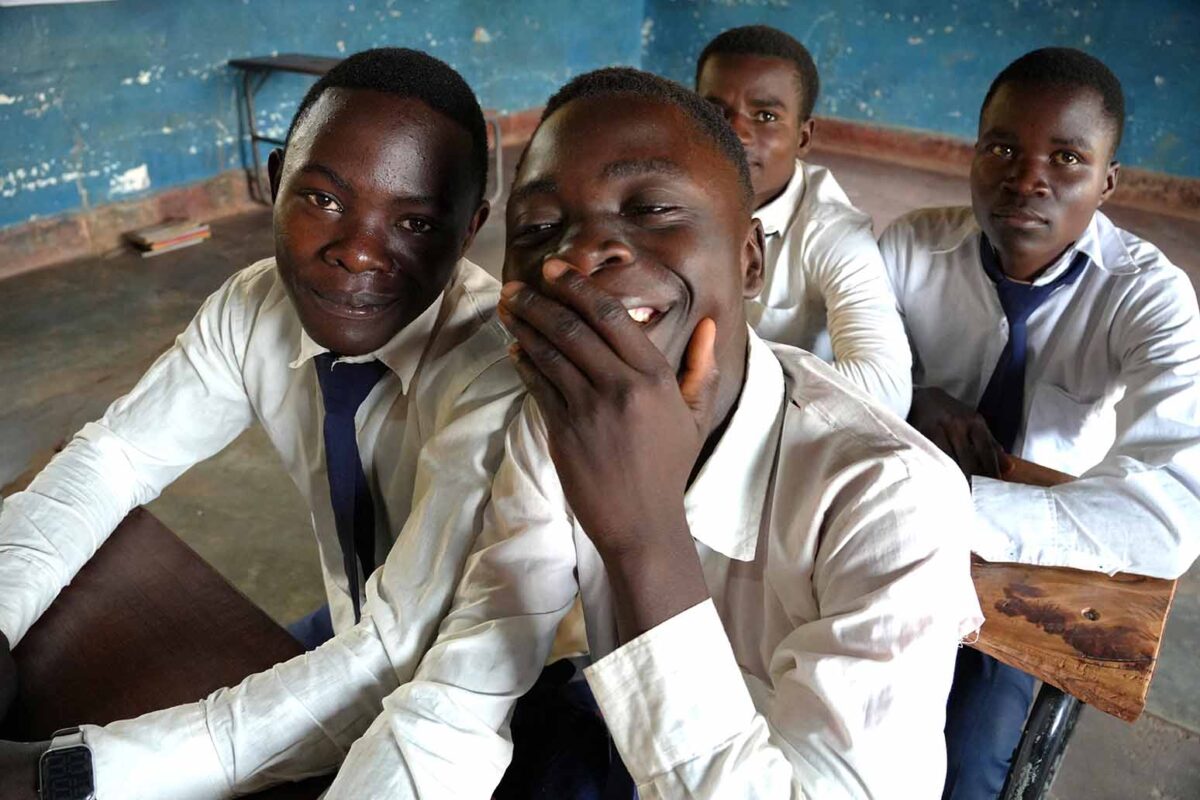
The day starts early for most students attending Mwami Primary School near Chipata, in the Eastern Province in Zambia. The “lucky ones” walk one mile or less to school in the morning and return in early afternoon. Others must walk two, three, and even four miles each way to get a formal education.

During the dry season—roughly from April to October—this means cutting through dusty paths and backroads from tiny settlements in the bush to the complex, which includes a few houses and the nearby Mwami Adventist Hospital. When the long-awaited rain arrives in November, it leads to trudging in the mud or, often, missing school altogether. “When it rains hard, hardly anyone comes,” Joyce Tembo, head teacher of Mwami Primary School since 2012, shares. “Here there are no raincoats or umbrellas, so they just stay home.”

Education at Any Cost
The run-down facilities have outlasted their usefulness. Across 16 mostly dilapidated classrooms, 632 primary school students and a total of six eighth- and ninth-grade classes strive to obtain a Christian education thanks to the steady commitment of 18 teachers.

“Most of the parents of these children are subsistence farmers,” Tembo explained. “Even though education is free in Zambia, just making it possible for children to attend school and learn is no easy feat.”

School leaders explained how neighbors partner to prepare the fields and grow some corn for personal consumption, as they hope to harvest sunflower seeds, beans, and onions to sell. “That money helps us to pay for their uniforms or purchase a bar of soap so the kids can wash before attending school.”

Focus on Principles and Values
But there’s another reason that moves parents to send their children to the Adventist school. “I felt drawn to the Adventist school’s emphasis on morals. It’s what I also want for my children.”

For Tembo, Christian principles are an essential part of the education provided at Mwami. “Some of our students do not share our same beliefs,” she acknowledged, but the school makes the most of the daily morning worship and religious education classes.

Every year, the Mwami School holds three special Week of Prayer meetings, one per school term, Tembo explained. “At the end of a Week of Prayer, the school always holds a baptismal ceremony for students who have requested baptism,” she reported.

A New Dawn of Possibilities
In 2023 supporting ministry Maranatha Volunteers International, which builds churches and schools and drills water wells around the world, stepped in to support Adventist education efforts in the area. Soon, with the support of a local crew and international volunteers, a spacious building was built, with 14 new classrooms and a central hall that can double as a church and includes seating for more than 1,000 people.

A recent visit to Mwami Primary School in October took place just before the official inauguration of the new facilities, located a few hundred yards from the old building. “I am ecstatic about the new school,” one of the older students commented, explaining that they were told the eighth and ninth graders would soon move to the new facilities. They will become part of the new secondary school, which will keep adding until reaching the twelfth grade. “I feel a burden has been lifted,” she said.

Closing the Gap
For Tembo and Susiku Maxwell, math teacher at Mwami since 2014, the much-needed new facilities will close a gap in education. As the first secondary school in the area, it will help students to stay in school until they finish. “In this area, if a secondary school is too far, parents just stop sending their children to school,” Tembo explained.

For Maxwell, it’s a shame, especially in the context of Adventist education. “We have the primary school, and at Mwami Hospital there’s a college of nursing,” he explained. “But we are losing students in between, who stop studying before reaching college age. Some also get disconnected from church during their teenage years. This new secondary school will close that gap and help students get professional training if they desire to do so, and stay in the Adventist Church.”

Tembo agreed. “The children of these farmers—some of whom never went to school—will reach further, thanks to Seventh-day Adventist education.”
This and other reasons make Maxwell impatient. “As soon as [the new school] opens, I want to go teach there,” he said.

Meanwhile, both faculty and students emphasize they are deeply grateful for the support they have received from church leaders and Maranatha supporters and donors. In the words of an eighth grader: “Thank you, Maranatha, for believing in us,” she said. “It looks like I’m in heaven!”
