November 1, 2019
Houseplants: Harmful Or Healthful?
Plants are God’s natural air purifiers.
Peter N. Landless and Zeno L. Charles-Marcel

Q:My husband believes that houseplants are not healthy for the bedroom because they produce “bad gases” that could be harmful. I think they keep the air clean. Do they help or hurt?
A:In general, houseplants are healthful, beautifying additions to any room. God created plants to produce life-giving oxygen and consume the waste-product gas carbon dioxide (CO2) in daylight. In darkness, most common plants act like humans (and all air-breathing creatures) in that they consume oxygen and produce carbon dioxide. In very high concentrations this gas is not healthful, but it is sometimes confused with another gas, carbon monoxide (CO), which is highly toxic and has nothing to do with plants.
The toxicity of
carbon monoxide in automobile tailpipe exhaust emissions is well publicized, but tailpipe exhaust emissions,we’re told, are a major source of the “deadly greenhouse gas” carbon dioxide (CO2). No wonder these two gases may be confused. Neither plants nor humans produce carbon monoxide. If sleeping with a human or pet in your room at night poses no threat, neither does sleeping with houseplants.
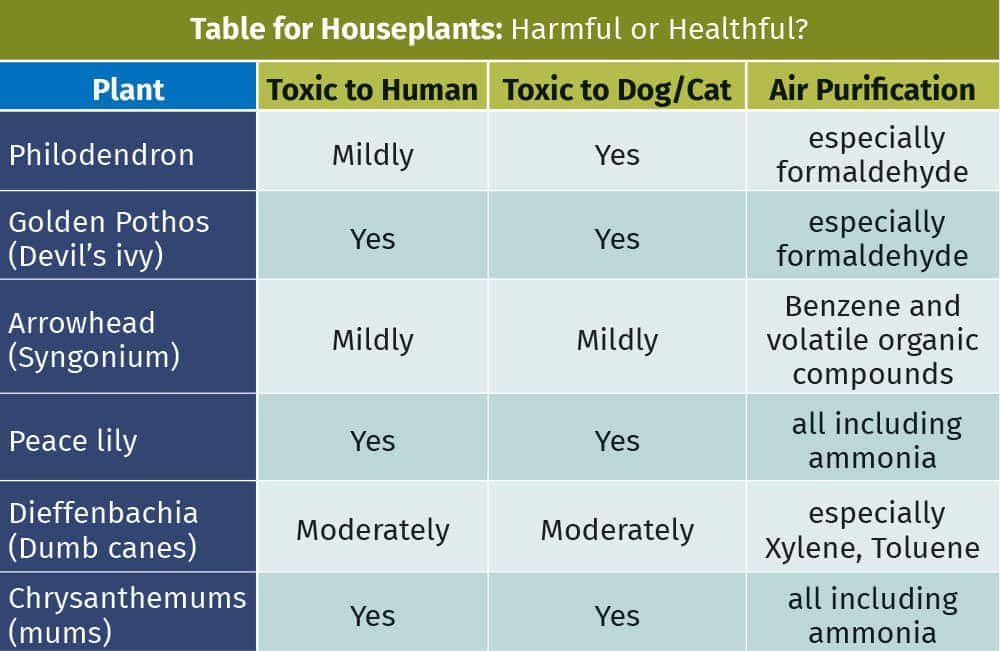
Nonetheless, some houseplants can be hazardous to people or pets (see table). We advise keeping all houseplants out of the reach of those who might crush, eat, or taste them.
In 1989 the National Aeronautics and Space Administration (NASA), in association with the Associated Landscape Contractors of America (ALCA) studied the effectiveness of houseplants as air-purification systems in space facilities. Several houseplant air purifiers filter out common, volatile organic compounds such as benzene, toluene, ammonia, formaldehyde, xylene, trichloroethylene (common indoor air pollutants), and even carbon monoxide from the air! These plants include the peace lily (Mauna Loa), florist’s chrysanthemum, English ivy, variegated snake plant (mother-in-law’s tongue), red-edged dracaena, spider plant, and gerbera daisy.
Basic facts:
Plants are God’s natural air purifiers.
All humans and air-breathing creatures remove oxygen and add CO
2, while houseplants remove CO2 and add oxygen during the day. (Humans add 100 times more CO2 than the average houseplant.)
Different plant species have different efficiency and effectiveness for any given polluting chemical, so houseplant combinations work best for indoor air purification.
Overwatering plants, a common problem, can create excessive soil moisture and promote mold growth—not a healthful situation.
At least one plant per 100 square feet of home or office space is required for efficient air cleaning, according to NASA researchers.
Some houseplants have fragrances (chemicals) that are irritants or toxins or provoke allergies. So even if a plant is a great air purifier, it may not be prudent to use it if someone in the household or office is allergic to the plant or uniquely sensitive to its fragrance.
Peter N. Landless, a board-certified nuclear cardiologist, is director of the General Conference Health Ministries Department. Zeno L. Charles-Marcel, a board-certified internist, is an associate director of Adventist Health Ministries at the General Conference.
About the Author
Zeno L. Charles-Marcel, a board-certified internist, is the director of Adventist Health Ministries at the General Conference. Peter N. Landless, a board-certified nuclear cardiologist and General Conference Adventist Health Ministries director emeritus, is also a board-certified internist.
Zeno L. Charles-Marcel, a board-certified internist, is the director of Adventist Health Ministries at the General Conference.
Sign up for the newsletter
Get the latest Adventist news straight into your inbox.
Follow us:
Related

AdventHealth Will Help Bring Health Care to Homeless Families
Soon, in Florida, United States, a new health-care model driven by AdventHealth will bring care directly to families experiencing homelessness.
November 23, 2026

Prayers for Healing—Do They Work?
My patient had been so certain that God had answered his prayers for healing and had completely cured him. Why had God allowed him to believe he was healed, only for the cancer to return?
November 21, 2026

The Sweet Truth
Honey, maple syrup, agave . . . healthier than sugar? Not exactly. Learn the sweet truth about natural sweeteners and how to enjoy them wisely.
November 19, 2026

A World of Possibilities for Those on the Spectrum
A recent conference sought to create more awareness about disabilities, and discussed what local Adventist congregations can do to welcome more people.
November 19, 2026
Comments
Advertisement
