April 7, 2015
Was Eri L. Barr the First Black Adventist Minister?
by

By Stanley D. Hickerson
Many years ago, Charles F. Stevens, brother of Mrs. Uriah Smith and Mrs. J.N. Andrews, wrote a letter recalling the early days of the Seventh-day Adventist work in the New England states.
In the letter, housed in the vault at the Center for Adventist Research in the James White Library at Andrews University, he lists several of the earliest Adventist ministers. After the name of E.L. Barr, Stevens placed the word “colored” in parenthesis. While the designation suggests a racial identification no longer acceptable, the addition provides important historical background.
The name, E.L. Barr, is not new to Adventist historians. But the idea that he might be African-American is new.
For decades, Adventists have recognized Charles M. Kinney (1855-1951) as the first black ordained Seventh-day Adventist minister, beginning his ministry in 1889 in Louisville, Kentucky. But was he really the first?
No photos have surfaced of Barr, but research inspired by the discovery of the clue in Stevens’ letter has led to historically significant results.
Eri L. Barr, was born in Reading, Vermont, on May 23, 1814, to the family of William Barr, a “free colored” person who had lived in Reading since at least 1810.
Eri was sent to Wesleyan Academy in Wilbraham, Massachusetts, for his education. Wesleyan, founded as a Methodist ministerial training school, was co-educational and admitted blacks. The 1836 catalog of the academy lists Eri L. Barr, from Reading, Vermont, as a former student in the English department. Just how long he studied there, or if he graduated, remains unknown.
E.L. Barr married Lori Z. Harvey on Dec. 7, 1842. He also accepted the doctrine of the soon coming of Christ, and was, no doubt, bitterly disappointed when Christ did not come as expected in 1843 and then 1844.
The 1850 U.S. Census records Eri, Lori, a 6-year-old daughter, Emma, along with Eri’s brother Horace and Lori’s mother all living in Goshen Gore, Vermont. Eri is listed as a mechanic and his “color” as “mulatto.”
About 1852, E.L. Barr accepted the Sabbath and began preaching the third angel’s message from Revelation 14. He traveled from town to town and from state to state, all around New England preaching the message and encouraging the believers.
On Sept. 30, 1852, Adventist Church cofounder Ellen White had a vision in Dorchester, Massachusetts, in which she saw that Barr was among the preachers “to be depended upon.” Her husband, church cofounder James White, recorded this vision in a letter addressed to “Dear Brother” on the same date.
Barr and his wife, Lori, divorced on Dec. 10, 1858, just three days after their 16th wedding anniversary. The cause — “willing absence” — was likely a reference to Barr’s frequent travels away from home.
In 1859, Barr, no doubt still reeling from the trauma of his family’s collapse, began to drift toward some extreme views and to regard all photographs as a breach of the second commandment. He preached these new ideas for a time. Ellen White warned him of the dangers of fanaticism, and he sent a hearty confession to the magazine today known as the Adventist Review, expressing “perfect confidence in the gifts of the Spirit, and the testimonies given thereby.”
In 1859, Barr began laboring in upstate New York, and the 1860 U.S. Census records Barr as an “Advent Clergyman” living with the Josiah Witter family in Willing, New York.
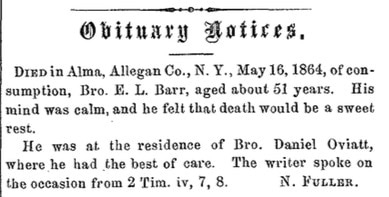
But tuberculosis, lethal to so many of early Adventist leaders, attacked the Adventist minister. Eri. L. Barr, only 51 years old, died May 16, 1864, in Alma, New York, where he was being cared for by fellow believer Daniel Oviatt. He was buried in the Bellamy Cemetery, in Alma.
His brother Horace remained in Vermont, where he served as a local elder of the Andover Seventh-day Adventist church for many years. Horace died in 1886 at the age of 71.
Stanley D. Hickerson is annotation project director at the Ellen G. White Estate.
About the Author
Sign up for the newsletter
Get the latest Adventist news straight into your inbox.
Follow us:
Related

A Handful of Walnuts a Day May Make Your Diet Less Inflammatory
Published research findings add to previous studies about the role of nuts in human diet.
Larry Becker
October 18, 2026

Adventist Intercultural Marriages Have Skyrocketed. Is That a Positive Sign?
A pastor and psychotherapist dissects the implications of an increasing trend.
Marcos Paseggi
October 16, 2026

Treasurer Confirms Record Mission Investment Ahead of OneVoice27
Paul H. Douglas’ report highlights mobilization of resources “as never before.”
Marcos Paseggi
October 15, 2026

Church Manual Will Undergo “Comprehensive” Revision Before 2030
Delegates seek clarity on scope of revision, and motion passes 167 to 32.
Jarrod Stackelroth
October 15, 2026
Comments
Advertisement
