December 21, 2018
Religions Should Inform, Underpin Human Rights Efforts
by

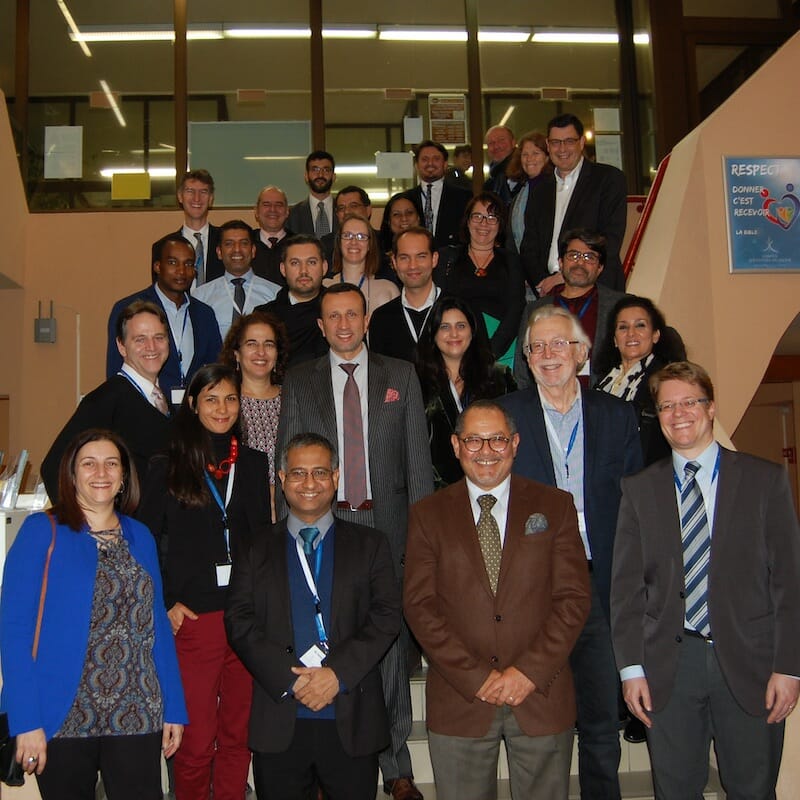
On December 13-14, 2018, the Adventist Campus of Salève, Haute-Savoie, France, also known as the Adventist University of France, hosted a meeting at the initiative of the Office of the United Nations High Commissioner for Human Rights (OHCHR) to work on human rights awareness and training resources for agents of faith.
2018 marks 70 years since the Universal Declaration of Human Rights, but this group of experts was involved in the dynamics of the 2012 Rabat action plan and the 2017 Beirut declaration, along with 18 events focusing on faith for rights.
Not only is it possible to recognize certain religious roots in human rights, but different religions and agents of faith can be driving forces in the assimilation and application of human rights. Currently, there is a tendency toward a highly secularized view of human rights and a habit of seeing religions more as a problem, while in reality they have a significant role to play in the solution.
The profile of the 36 experts participating in this symposium was varied, allowing for the emergence of different ideas and contributions. Along with the OHCHR employees, under the direction of Ibrahim Salama and Michael Wiener, two Special Rapporteurs were present: The Special Rapporteur on freedom of religion or belief and the Special Rapporteur on minority issues.
Also among the participants were OHCHR Treaty Bodies members, heads of non-governmental organizations, academics, and diplomats, as well as artists, religious leaders, theologians, and legal experts. The experts came from the Middle East, North Africa, and the four corners of the earth, all involved in or interested in the relation between religions and human rights.
It is not inconsequential that this meeting took place in a school, and notably in a school where faith holds an important position. The existence of the International Centre for Religious Freedom and Public Affairs on the Adventist Campus of Salève contributed to the holding of this UN meeting at Collonges. Moreover, the meeting of UN OHCHR experts on the Adventist campus was an exceptional event for the Adventist academic world.
The two days of meeting allowed for intense debates in a highly constructive listening and sharing spirit. The complexity of the topic was not avoided, but the participants’ shared desire that religious agents would be proactive in terms of human rights was clear. The breadth of the discussion included the defense of freedoms of conscience and religion, the right to change, and also respecting minorities, promoting gender equality, defending children’s rights, and, finally, promoting different types of dialogue.
The methodological approach to this meeting integrated periods of discussion and plenary debates, as well as testimonies of experiences in progress, workshops on brainstorming in small groups, and an evening when art was the center of attention through music and calligraphy.
It is encouraging to see that respect, freedom, and honest dialogue have already been put to the test at the level of experts working on projects, because this is probably the first important step toward ensuring that all the agents, especially agents of faith, will be driving forces of authentic and effective experiences of human rights.
This meeting was, therefore, the first step in anticipation of preparation for training resources, and useful for ensuring that “faith and rights” are in synergy. The foundation has been established at Collonges; there is no doubt that the outcome of this work will be a considerable contribution in preparation for peaceful relations between religious groups and public authorities, between theistic and non-theistic believers, atheists, or others, and between religions.
About the Author
adventist-review
Sign up for the newsletter
Get the latest Adventist news straight into your inbox.
Follow us:
Related

Adventist Intercultural Marriages Have Skyrocketed. Is That a Positive Sign?
A pastor and psychotherapist dissects the implications of an increasing trend.
Marcos Paseggi
October 16, 2026

From Deep-rooted Trauma to Laughing (and Crying) Again
In Spain an intercultural camp for vulnerable children is changing one life at a time.
Marcos Paseggi
October 8, 2026

More Than 300 Lay “Evangelists” from Across Europe Recommit to Mission
“Before business, we live to share Jesus,” ASi Europe leader says.
Marcos Paseggi
October 5, 2026

I Have Lived With Cerebral Palsy for 72 Years. Why Has God Allowed It?
Why I believe that my suffering is compatible with my belief in a loving God.
Geoffrey Panckhurst
September 27, 2026
Comments
Advertisement
