
Adventism entered Lucknow as early as the first decade of the twentieth century. Luther and Georgia Burgess pioneered mission work in several locations in northern India. As a result of their efforts, the first Hindustani church was organized during the 1908 biennial conference in Lucknow.1 In 1909, about 13 years after the India Mission was established in Calcutta, its headquarters was relocated to Lucknow. The publishing house was also moved to this location.
As the various branches of mission work rapidly developed, the need for qualified Adventist workers increased. The Union Advisory Board passed a resolution on April 12, 1914, for the founding of a central union school for the entire India Union Mission. It was agreed that until the buildings were completed, the school was to operate in rented buildings.
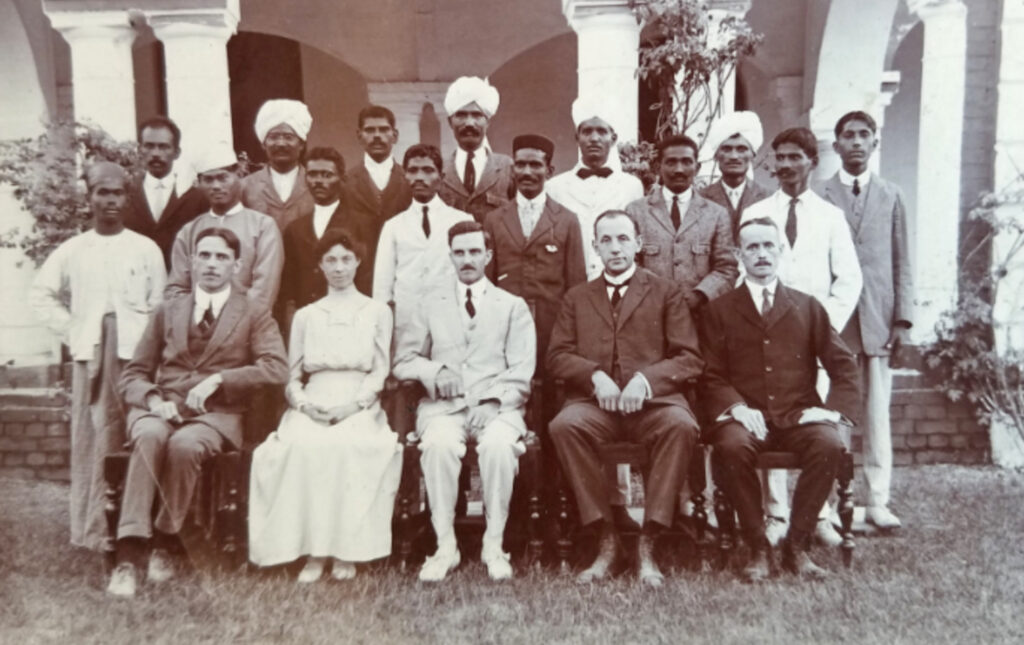
As planned, the Indian Christian Training School (ICTS), as it came to be known, opened on November 3, 1915, in a large, rented bungalow within a large compound on 17 Abbott Road, Lucknow, where both the church headquarters and the publishing house were also located. The existing storerooms were cleaned up and sanitized and converted into hostels. The Foreign Mission Board sent I. Frank Blue, a former professor at Union College, to be the founding principal of the school. The school in Lucknow was established especially for the training of Indian leaders, evangelists, and teachers. In the first year there were 14 students. They came from Tamil Nadu, Burma, West India, Andhra Pradesh, northwest India, and North India.2 Instruction was given in English. The school managing board consisted of W. W. Fletcher, I. F. Blue, and S. A. Wellman.
In 1916, student enrollment increased to 22.3 Students came from Andhra Pradesh, Burma, Bengal area, Maharashtra, Gujarat, and several parts of northern India. All students received financial assistance during their study in the school. In 1918, the school was relocated to 61 Abbot Road within the city.
Earnest efforts were made to provide a wholistic education at the school. Students were engaged in manual activities aside from studying the Bible and other subjects. They also actively participated in outreach ministry such as home visitations, mailing papers, selling tracts, and lending or giving away books and tracts.
Soon after its establishment, I. F. Blue temporarily withdrew from his position as the school principal because of a serious case of diphtheria. A. H. Williams temporarily oversaw the administration of the school. Although Blue returned to the school in January 1916, his sickness forced him to return to America.
ICTS declined. Language was the main cause for the school’s downfall.4 Students who came from different regions did not fully understand English, the medium of instruction. To bring together students with diverse languages and cultures into one school and train them with the same method was in its early experimental stage. Eric M. Meleen, who was actively engaged in educational initiatives in India, expressed a similar tone when he wrote, “The differences in the languages of the people in India make a central training school impracticable. . . . It seems to me we will have to have several small training schools in different sections of the country.”5
In the end, the church leadership in India felt that it would serve the cause of the church better if training was provided in smaller regional schools rather than bringing all the students to one centralized institution. Blue shared this sentiment as well. After a string of disappointments and low enrollments, the school was closed down sometime in 1919. Though short-lived, ICTS provided the church with valuable insight into how to better organize schools to train mission workers in the future.
1J. L. Shaw, “Mission Headquarters,” The Advent Review and Sabbath Herald, June 19, 1913, p. 19.
2I. F. Blue, “Opening of the Indian Christian Training School,” Eastern Tidings, Nov. 1915, pp. 2, 3.
3J. F. Blue, “Indian Christian Training School,” Eastern Tidings, Nov. 1916, p. 7.
4George R. Jenson, Spicer Memorial College: A Dynamic Demonstration of an Ideal (Poona, India: Oriental Watchman, 1965), pp. 21, 33.
5Eric M. Meleen, “The Training School—Its Object and Purpose,” Eastern Tidings, May 15, 1920, p. 2.
About the Author
Merle Poirier
Sign up for the newsletter
Get the latest Adventist news straight into your inbox.
Follow us:
Related

Treasurer Confirms Record Mission Investment Ahead of OneVoice27
Paul H. Douglas’ report highlights mobilization of resources “as never before.”
Marcos Paseggi
October 15, 2026

Church Manual Will Undergo “Comprehensive” Revision Before 2030
Delegates seek clarity on scope of revision, and motion passes 167 to 32.
Jarrod Stackelroth
October 15, 2026

Adventist Church Marks 100 Years of Working Policy
“Policy is the framework that makes mission possible,” church leaders say.
Libna Stevens
October 14, 2026

Global Mission Centers Introduce New Bible Studies for Diverse Communities
In response to frequent requests for contextualized Bible study resources, the Seventh-day Adventist Church’s Global Mission Centers have developed six new study guides adaptable to local communities.
Alyssa Truman
October 13, 2026
Comments
Advertisement
