April 22, 2015
Avoiding a Sabbath Plane Flight Saved My Life
by

One of the most frightening experiences of my life took place last month.
I was supposed to fly from Washington to Zurich, Switzerland, on the evening of March 14. Earlier when I searched for flights, I found two possibilities — a nonstop flight departing at 5:40 p.m., and a two-segment flight through London that departed at 11 p.m.
Undoubtedly, the first option was the best one. But I ended up buying the second route. The reason was simple: March 14 was a Saturday, and I avoid flying on the Sabbath, except for an emergency.
That Sabbath morning I attended church with my wife and son, and afterward we ate a good lunch. Around 5 p.m. my stomach started feeling somewhat upset. I thought it was nothing serious, and after sunset my wife dropped me off at the Washington-Dulles International Airport for my 11 p.m. flight.
But the closer it came to boarding time, the more abdominal pain and nausea I felt. With growing desperation, I finally prayed, “Lord, I don’t recall having ever heard Your audible voice before. But now I really need You to tell me plainly whether or not I should board this airplane.”
Instead of speaking directly to me, the Lord used a friendly United Airlines agent to guide me in the right direction.
When I asked about the possibility of changing my flight to the next day, she inquired how I was feeling and whether she should call the paramedics. With some time of reluctance, I finally agreed. The paramedics took me through a back door to an ambulance, which rushed me to the nearby Reston Hospital Center. My abdomen had swelled up like a balloon, and only injections of Dilaudid, which is much stronger than morphine, could control the blinding pain.
A PET Scan and X-rays showed a complete bowel obstruction on the small intestine and mid-jejunum. It could be a tumor. The doctors ran a battery of tests on Sunday and Monday. Then on Monday evening, the surgeon performed a laparoscopy — three small incisions — by which he identified and cut a small piece of tissue, like a string, freeing the adhesion to the retroperitoneum that was causing the problem. It was a simple procedure.
Praise the Lord, two days later I was released from the hospital to go back home.
What Could Have Happened?
We are told that “our heavenly Father has a thousand ways to provide for us, of which we know nothing. Those who accept the one principle of making the service and honor of God supreme will find perplexities vanish, and a plain path before their feet” (
The Desire of Ages p. 330).
This means that God could have solved my health problem in a different way. But from my limited human perspective, I can only imagine what would have happened if my bowel obstruction happened exactly as it did, but I had decided to follow another path.
For instance, what would have happened if I had simply disregarded the inspired counsel of avoiding unnecessary trips during the Sabbath hours and ended up taking the 5:40 p.m. flight? Most certainly, my severe pain and nausea would have showed up while crossing the Atlantic Ocean. Since cabin air pressure at cruising altitude is lower than at sea level, my pain and nausea would have been even more intense. In addition, commercial airplanes are not equipped to handle such problems.
On the other hand, if my severe pain had started just a little bit later, most certainly I would have boarded the 11 p.m. flight. In this case, the airplane would have needed to return to the departure airport or to land at another airport on the northeast coast of North America.
But my problem also could have started farther away from home, either while I waited for my connection at London’s Heathrow Airport or even during my train trip from Zurich to Bern. Of course, these are only human speculations. But I am convinced that my problem occurred exactly at the least risky time, with an easy way out.
What Did I Learn?
Crises are God’s opportunities to remind us of some realities that we do not always take as seriously as we should. During the 56 years of my life, I have never had any surgery.
But the four days I spent at the hospital helped me to see that our lives are more fragile than we usually realize. Isaiah 40 even compares human beings with the grass that remains green for a while and then withers, and the flowers that bloom for a short time and then fade (verses 6, 7). But the same chapter also adds that “those who wait on the Lord shall renew their strength; they shall mount up with wings like eagles, they shall run and not be weary, they shall walk and not faint” (verse 31).
Another reality that crossed my mind at the hospital is that we can control some things but not everything. There are circumstances in life that are far beyond our controlling power. A voice from heaven told King Nebuchadnezzar that “the Most High rules in the kingdom of men” (Daniel 4:32) and, by extension, also overrules our own lives. Although we may not understand exactly why certain problems show up in our path, we should not forget that “God never leads His children otherwise than they would choose to be led, if they could see the end from the beginning and discern the glory of the purpose which they are fulfilling as co-workers with Him” (
Ministry of Healing, p. 479).
A third significant reality is that sometimes we need to stop the routine of our lives and rethink our priorities. Adventist Church cofounder Ellen G. White declares: “As activity increases and men become successful in doing any work for God, there is danger of trusting to human plans and methods. There is a tendency to pray less, and to have less faith. Like the disciples, we are in danger of losing sight of our dependence on God, and seeking to make a savior of our activity” (
The Desire of Ages, page 362).
Oswald Chambers warns: “Beware of anything that competes with your loyalty to Jesus Christ. The greatest competitor of true devotion to Jesus is the service for Him. It is easier to serve than to pour out our lives completely for Him” (
My Utmost for His Highest, reading for Jan. 18).
Shortly after I arrived back home from the hospital, a brother-in-law sent me
the YouTube link of the Gaither Vocal Band’s meaningful song, “Sometimes It Takes a Mountain.” The chorus says, “Sometimes it takes a mountain, sometimes a troubled sea, sometimes it takes a desert to get a hold of me.”
The song suggests that God sometimes allows us to pass through significant crises in order to bring us closer to Him. By contrast, what a difference it makes in life when we remain always commited to God and His Word, regardless of the circumstances!
We live within the great controversy between God and His holy angels and Satan and his evil angels, meaning that many of our life incidents are not yet fully understandable. But in the heavenly school, “every redeemed one will understand the ministry of angels in his own life. The angel who was his guardian from his earliest moment; the angel who watched his steps, and covered his head in the day of peril; the angel who was with him in the valley of the shadow of death, who marked his resting place, who was the first to greet him in the resurrection morning—what will it be to hold converse with him, and to learn the history of divine interposition in the individual life, of heavenly co-operation in every work for humanity!” (
Education, p. 305).
God did not promise to free us from all life storms but rather to be with us in the midst of them. Remember when the wind and the waves obeyed Jesus in Matt. 8:23-27? Jesus told his terrified disciples on the boat: “Why are you fearful, O you of little faith?”
Jesus even said to His followers: “In the world you will have tribulation; but be of good cheer.” “I am with you always, even to the end of the age” (John 16:33; Matt 28:20).
And this makes all the difference.
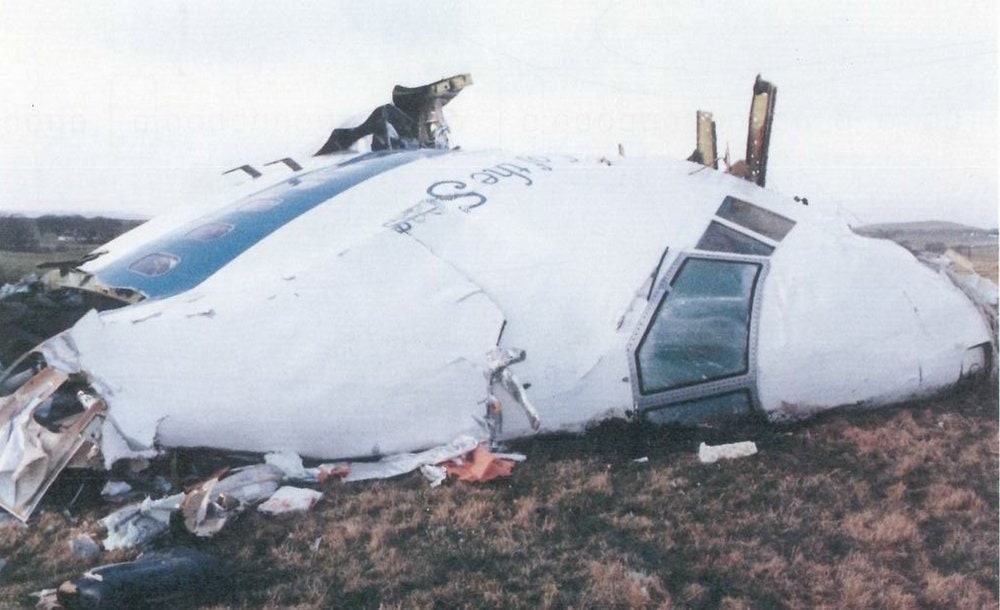
Prayer Kept Me Off a Bombed Plane
Editor’s note: Several Adventists have had close calls with plane accidents, including a Dutch woman who at the last minute changed her ticket from the Malaysia Airlines jet that was shot down over Ukraine last summer. This is another story, a version of which appeared in the Adventist Review in April 1997 and previously was unavailable online.
By Michael G. Hasel, professor of Near Eastern studies and archeology, Southern Adventist University
Three months into my year of college study abroad in Austria, my father called to invite me to join my family in the U.S. for Christmas.
I faced a wrenching decision.
Sunny Florida certainly had its appeal — especially against the cold, gray, wintry backdrop of rain at Bogenhofen Seminary. But I wasn’t sure I should go. Christmas with relatives in nearby Germany and the possibility of a ski trip to Switzerland were appealing as well.

“I’ll call you back in four hours,” Dad said.
It was lunchtime, and I had promised to take two friends into town. When I explained my dilemma, we decided to pray. Although it seemed rather unnecessary to pray about such a simple thing, we believed that no situation is unimportant to God.
About 15 minutes before my father called back, I suddenly knew it would be best to stay in Europe.
When the phone rang, I answered it with new confidence, only to have my resolve shaken by my father’s announcement: “Michael, guess what? I was able to book you on one of the last flights available. You will be flying from Frankfurt via London to New York and then to Miami. We can pick you up there!”
Confused, I felt my resolve fading fast.
“But Dad,” I said, “I’ve already made my decision. I’ve decided … well, I’ve decided to stay here. It’s not that I don’t miss you, but I can be in Florida again next year.”
My father understood, but he told me to call him if I changed my mind. “The booking will hold another three days,” he said.
I didn’t change my mind.
Two weeks later, I found myself at my cousin’s home in southern Germany on Christmas Eve. We had just finished reading the gospel account of Christ’s birth and were sitting around the Christmas tree in the flickering candlelight, opening presents, when the telephone rang. It was my father.
“Michael, there’s something I have to tell you,” he said. “I’m glad you didn’t come to Florida. You made the right decision.”
“Why?” I asked. “Don’t you all miss me?”
“No, it’s not that,” he said. “The flight that I had you booked on was the Pan Am Flight 103 that crashed in Lockerbie, Scotland.”
I sat stunned. The candlelight danced around in my mind. I forgot about the gifts and stared at the tree. I remembered the radio reports we had heard as we drove from Bogenhofen days earlier on Dec. 21, 1988. All 259 people aboard the plane, including 35 students from Syracuse University, had died, as well as had 11 people on the ground. Only much later did U.S. investigators announce that the Boeing 747 jumbo jet, flying from Frankfurt to Detroit with stops in London and New York, had been brought down by a bomb planted by Libyan terrorists.
For weeks I contemplated Pan Am’s Flight 103, searching my heart for answers. Why me? Why was I spared while so many other lives were lost? The memory of my friends and my kneeling before God, asking Him to guide in my decision, surfaced again and again. It was His answer to that prayer that saved my life.
I still don’t know why some are spared and some are not.
But I do know that God answered my prayer that day and continues to fill my life with more than I can imagine. Hebrews 12:1, 2 says, “Let us run with perseverance the race marked out for us. Let us fix our eyes on Jesus, the author and perfecter of our faith, who for the joy set before him endured the cross, scorning its shame, and sat down at the right hand of the throne of God” (NIV).
Indeed, God has given me an opportunity to finish the race and to finish it well. It’s a goal He sets before each of us.
Read related story: “She Missed Flight 17 Because of the Sabbath”
About the Author
Adventist Review
Sign up for the newsletter
Get the latest Adventist news straight into your inbox.
Follow us:
Related

A Handful of Walnuts a Day May Make Your Diet Less Inflammatory
Published research findings add to previous studies about the role of nuts in human diet.
Larry Becker
October 18, 2026

Assurance in the Judgment
The psalmist actually welcomed―yes, even longed for―the judgment.
Richard Davidson
October 17, 2026

Adventist Intercultural Marriages Have Skyrocketed. Is That a Positive Sign?
A pastor and psychotherapist dissects the implications of an increasing trend.
Marcos Paseggi
October 16, 2026

Treasurer Confirms Record Mission Investment Ahead of OneVoice27
Paul H. Douglas’ report highlights mobilization of resources “as never before.”
Marcos Paseggi
October 15, 2026
Comments
Advertisement
