
By Andrew McChesney, news editor, Adventist Review
In 1960, around 54 percent of all Seventh-day Adventists lived in Africa, Asia, and Latin America.
Today, church membership in the so-called Global South has reached 16.9 million, or 92 percent of the world church membership.
The major changes don’t stop there, G.T. Ng, executive secretary of the Adventist world church, said Sunday as he presented his yearly secretary’s report at the Annual Council.
China now has more Adventists than in all of Europe, he said. More Adventists live in Zambia, which has a population of 15 million, than in the Middle East and Northern Africa region, which has a population of 519 million. Brazil has more Adventists than Britain, Canada, and the United States combined.
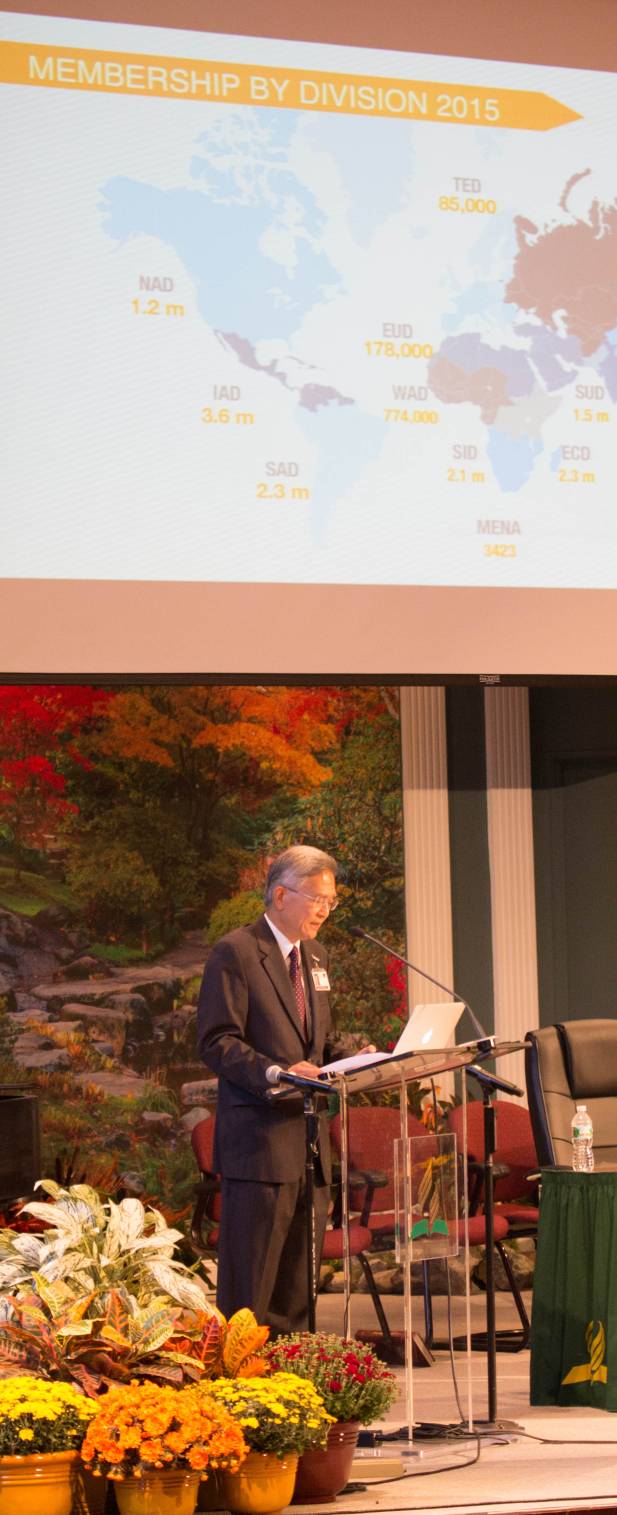
“We clearly see that the demographic center of gravity of our church has definitively shifted,” Ng told church leaders and laypeople at the Annual Council business meeting at world church headquarters in Silver Spring, Maryland.
As a result, he said, “countries that were once destinations for Western missionaries are now sending their own missionaries to various continents and beyond.”
These shift in the demographic center of gravity means that the church, founded by a small group of Americans in 1863, faces new global realties as its membership approaches 18.8 million, Adventist world church leaders said.
Church membership reached 18,778,932 on June 30, 2015, up from 18,479,750 on Dec. 31, 2014, David Trim, director of the church’s Office of Archives, Statistics, and Research, told the Annual Council. The number of congregations — which consist of churches and companies, increased to 149,850 from 148,023 over the same six-month period.
Ng, who used his secretary’s report last year to raise the alarm about member retention, took a hard look on Sunday at the need of the Adventist Church to penetrate difficult-to-reach regions of the world. He encouraged members in the wealthier North to continue contributing financially to mission work, but said staffing that mission would increasingly depend on the South.
North America and Europe long have supplied missionaries to the rest of the world, a role that Ng said remained vital for world mission. About half of long-term missionaries and inter-division employees currently come from the United States.
But as secularism and other factors slow membership growth in the North, Adventist leaders in those countries are understandably more interested in investing in evangelism at home than funneling energy and funds abroad, Ng said.
“Given the huge challenge of evangelizing in a post-secular context, the North is justifiably correct to channel more of its precious resources to the domestic constituency,” he said.
But, he noted, Adventist Church cofounder Ellen G. White makes it clear that church members do not have the option to choose between home mission and foreign mission because the support of foreign mission is essential for the survival of home mission.
“The prosperity of the home work depends largely, under God, upon the reflex influence of the evangelical work done in countries afar off,” Ng said, reading from White’s Testimonies for the Church, Vol. 6, page 27.
“America had sacrificed much in sending missionaries and funds to these foreign lands,” he said. “This spirit of self-sacrifice to foreign mission had resulted in a ‘reflex influence’ on home mission. The prosperity of one had given rise to the prosperity of another.”
Looking ahead, Ng said church members from the South increasingly would need to assist in spreading the gospel in challenging regions such as the Middle East and Northern Africa. Indeed, missionaries are already traveling between those regions. Earlier this year, the church’s South American Division dispatched 17 missionaries to the Middle East and North Africa Union for five-year terms that it is sponsoring. In addition, Adventist universities in Latin America aretraining students to serve as missionaries in the Middle East and North Africa.
Ng applauded the Adventist world church’s Office of Global Mission, which is celebrating its 25th anniversary this year, for its robust work in planting new congregations in unentered areas and among new people groups of the world.
But all praise for spreading the gospel belongs to God, he said. It is only “God who gives the increase,” he said, citing 1 Corinthians 3:7.
About the Author
adventist-review
Sign up for the newsletter
Get the latest Adventist news straight into your inbox.
Follow us:
Related

A Handful of Walnuts a Day May Make Your Diet Less Inflammatory
Published research findings add to previous studies about the role of nuts in human diet.
Larry Becker
October 18, 2026

Adventist Intercultural Marriages Have Skyrocketed. Is That a Positive Sign?
A pastor and psychotherapist dissects the implications of an increasing trend.
Marcos Paseggi
October 16, 2026

Treasurer Confirms Record Mission Investment Ahead of OneVoice27
Paul H. Douglas’ report highlights mobilization of resources “as never before.”
Marcos Paseggi
October 15, 2026

Church Manual Will Undergo “Comprehensive” Revision Before 2030
Delegates seek clarity on scope of revision, and motion passes 167 to 32.
Jarrod Stackelroth
October 15, 2026
Comments
Advertisement
