February 17, 2015
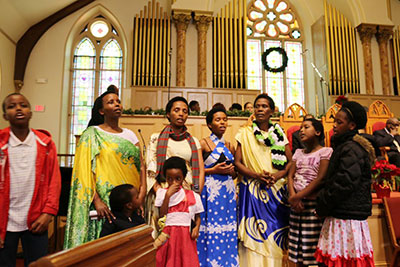
50 Congolese Refugees Show Up at Philadelphia Church
by

By Robert Booker, Columbia Union Visitor;
Richard Clark JR., assistant editor, Christian Record Services for the Blind;
and Andrew McChesney, news editor, Adventist Review
The phone call surprised the Ebenezer Adventist Church in Philadelphia.
The caller represented the Nationalities Service Center, an agency that assists the U.S. government in resettling refugees, and he said he had 50 people from the Democratic Republic of Congo who were looking for an Adventist house of worship.
Charts
Adventist Refugees by Country 2014
Congolese Refugees by Religion 2014
The refugees — a fraction of the 1,583 Congolese Adventists who resettled in the United States last year — had asked to be connected to a Seventh-day Adventist church upon leaving their war-torn homeland in Africa. The U.S. agency had determined that the Ebenezer Church was the closest to their new home in Philadelphia.
Ebenezer church members sprang into action.
The church secured the assistance of a man who speaks Kinyarwanda, the native tongue of the Congolese, and obtained Sabbath School lessons in Kinyarwanda. It also purchased translation equipment, transmitters, and earphones to interpret worship services into Kiswahili, which many of the refugees can understand.
“The church has rallied around these families,” said Crystal Drake, wife of Ebenezer pastor Charles Drake, who is spearheading the efforts. “They have given so much in clothing and household goods until we had to ask them to stop.”
The refugees’ arrival at the Ebenezer church may seem unusual, but the story should replay itself in other churches as Adventists reach out to a growing community of refugees in their neighborhoods, said Judy Aitken, founder of ASAP Ministries, an independent Adventist organization that works with refugees.
“God is calling on us to reach out to refugees who are destitute and are coming to us,” Aitken said.
In the United States, a total of 1,826 Adventists were among the 70,000 people granted refugee status last year, according to data from the U.S. Department of State’s Bureau of Population, Refugees, and Migration.
Eighty-seven percent of those Adventists —1,583 people — came from the Democratic Republic of the Congo, followed by Cuba (100 people), the former Soviet republic of Moldova (40), Myanmar (36), and Ukraine (34). An additional 51 Adventist refugees arrived in the first six weeks of 2015, including 35 Congolese.
Africa accounts for roughly a fourth of all refugees to the U.S., with the largest percentage of nearly half coming from the Middle East and South Asia. The larger proportion of Adventists from the Democratic Republic of the Congo may be linked to the fact that the church has a quarter million members in the country of 77 million.
More than 3 million people have been displaced by years of fighting between government forces and rebels, and 50,000 Congolese refugees alone are expected to settle in the United States by 2018.
While the government might come calling at times, Adventists should take the initiative to learn about refugee needs by visiting the local office of the Red Cross or Save the Children, Aitken said.
“Investigate and find out what refugees are coming to your cities and what you can do,” she said. “Then you can volunteer.”
She said that her daughter, a counselor in Albany, New York, volunteered at a refugee center and quickly adopted a family from Myanmar, taking members to the doctor and arranging for food stamps at social services.
But the understaffed refugee office gave her more refugees than she could manage, and she turned to other Adventists for help, including a pastor from Myanmar who also lived on the U.S. East Coast. The pastor ended up moving to Albany and opening a church for the refugees. Today, 80 to 100 people worship every Sabbath in the church, rented from a group of Adventist African Americans.
“I thank God when all Americans — no matter what nationality — can reach out to the people in their community,” Aitken said. “This is the work of Jesus.”
What You Can Do
When refugees arrive, they have virtually nothing they can call their own. Language acquisition, transportation, employment, and education are daunting hurdles that confront most of them.
If you live in an area where refugees are being resettled, consider reaching out to them and helping to meet their needs. Establishing personal friendships and church connections with the refugees at this time of great upheaval in their lives is crucial. Perhaps you can launch refugee ministries as an official outreach of your church.
“Many Asians do not feel that it is polite to go to a church unless they are invited, even if they are Seventh-day Adventists,” said Judy Aitken, founder of ASAP Ministries, an independent Adventist organization that works with refugees. “So if people would go door to door, I think there would be a lot of refugees coming to church.”
In what other ways can you support refugees? Here are some suggestions:
Make your church visible in your community so that refugees can find you easily. Could a visitor with no local acquaintances readily find where your church is located?
Start a van ministry at your church to help refugees be able to come worship with you on Sabbath or join in other church activities, such as Pathfinders. Refugees often need help with transportation.
Connect refugees with the resources available through your Adventist Community Services center. Cold weather clothes may be a special need.
As the number of refugees worshiping with you grows, provide a room on your church campus for them to meet in so that they can worship together in their heart language. Facilitate the organization of a branch Sabbath School or mission group.
Offer English-language classes for adults or tutoring for children and youth in your church fellowship hall or Adventist Community Services center. The Ebenezer Adventist Church in Philadelphia is preparing to start English classes for the 50 Congolese refugees who now attend worship services. It also holds job-training seminars for the group.
Sponsor refugee children to attend Adventist schools. Many refugees will be unable to send their children to Adventist schools without extra help. Providing refugee children with an Adventist education is one of the greatest gifts you can give them.
For more resources on how to support refugees, visit the websites of the North American Division-sponsored Adventist Refugee and Immigrant Ministries (refugeeministries.org), Reach the World Next Door (reachtheworldnextdoor.com), and ASAP Ministries (asapministries.org).
4 Quick Facts About Congolese Refugees
Congolese refugees, like all refugees, tend to settle among people of their own nationalities. Just as a number of refugees from Myanmar live in Albany, a sizable group of refugees from Laos have wound up in Holland, Michigan, where Adventists have also helped them establish a church.
The Congolese refugees who arrived in the United States last year resettled in 42 states and the District of Columbia. The top five states to receive Congolese refugees were Arizona (559 people), Texas (397), Pennsylvania (289), Georgia (264), and Massachusetts (233). The top five cities were Tucson (246), Phoenix (241), Atlanta (237), Denver (158), and Chicago (151).
The United States, which counted only about 4,000 people of Congolese descent in its 2000 census, resettled about 15,000 Congolese refugees from 2001 to 2014, and expects another 35,000 by 2018.
Perhaps the most prominent American of Congolese descent was Thurgood Marshall, architect of the successful
Brown v. Board of Education U.S. Supreme Court case that ultimately banned segregation in American public education, and later, an associate justice of the U.S. Supreme Court. Marshall was the great-grandson of a slave who was born in the modern-day Democratic Republic of the Congo. He died in 1991.
Congolese Refugees by Religion 2014
Religion | Female | Male | Total | Cumulative Total | Total % |
Bahai | 2 | 6 | 8 | 8 | 0.16% |
Baptist | 30 | 45 | 75 | 75 | .46% |
Catholic | 486 | 404 | 890 | 890 | 17.36% |
Christian | 155 | 175 | 330 | 330 | 6.44% |
Jehovah Witness | 49 | 55 | 104 | 104 | 2.03% |
Methodist | 74 | 58 | 132 | 132 | 2.57% |
Muslim | 90 | 90 | 180 | 180 | 3.51% |
No Religion | 1 | 5 | 6 | 6 | 0.12% |
Other Religion | 9 | 6 | 15 | 15 | 0.29% |
Pentecostalist | 530 | 487 | 1,017 | 1,017 | 19.83% |
Protestant | 386 | 375 | 761 | 761 | 14.84% |
Seventh-day Adventist | 807 | 776 | 1,583 | 1,583 | 30.87% |
Unknown | 14 | 13 | 27 | 27 | 0.53% |
Total | 2,633 | 2,495 | 5,128 | 5,128 |
Department of State, Bureau of Population, Refugees, and Migration, Office of Admissions – Refugee Processing Center
Calendar Year as of 31-December-2014
Adventist Refugees by Country 2014
Nationality | Total |
Burma | 37 |
Burundi | 2 |
Colombia | 2 |
Cuba | 100 |
Dem. Rep. Congo | 1,583 |
Eritrea | 1 |
Ethiopia | 3 |
Kazakhstan | 1 |
Moldova | 40 |
Republic of South Sudan | 4 |
Russia | 17 |
Rwanda | 2 |
Ukraine | 34 |
Total | 1,826 |
Department of State, Bureau of Population, Refugees, and Migration, Office of Admissions – Refugee Processing Center
Calendar Year as of 31-December-2014
About the Author
Sign up for the newsletter
Get the latest Adventist news straight into your inbox.
Follow us:
Related

A Handful of Walnuts a Day May Make Your Diet Less Inflammatory
Published research findings add to previous studies about the role of nuts in human diet.
Larry Becker
October 18, 2026

Adventist Intercultural Marriages Have Skyrocketed. Is That a Positive Sign?
A pastor and psychotherapist dissects the implications of an increasing trend.
Marcos Paseggi
October 16, 2026

Treasurer Confirms Record Mission Investment Ahead of OneVoice27
Paul H. Douglas’ report highlights mobilization of resources “as never before.”
Marcos Paseggi
October 15, 2026

Church Manual Will Undergo “Comprehensive” Revision Before 2030
Delegates seek clarity on scope of revision, and motion passes 167 to 32.
Jarrod Stackelroth
October 15, 2026
Comments
Advertisement
